Showing posts with label blogging. Show all posts

Monday, 19 April 2010

Football in 3-D: The Beautiful Game

blog for the skinny

As it's bright and sunny outside, everyone's wearing shades. But we're indoors, and not sitting-by-the-window indoors, we're deeply hidden away in Edinburgh's Three Sisters' backroom bar, round the corner from any mere vestige of sunlight, watching the telly. It's the Manchester derby, bizarrely now the richest city derby in world football, and we're wearing the darkened glasses because it's being shown on Sky 3-D.
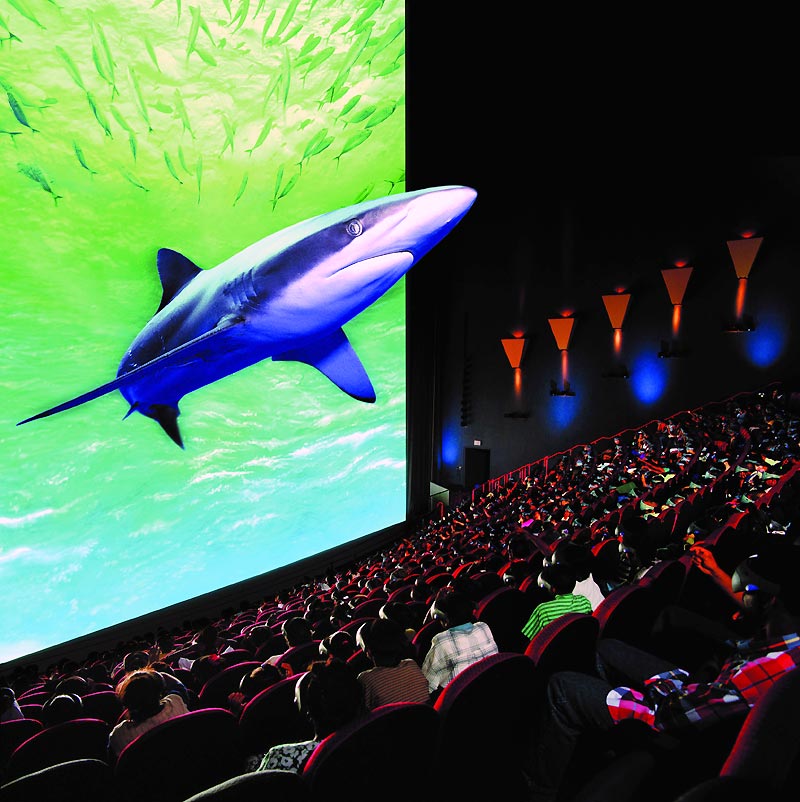

When I was a kid, a 3-D film was an attraction at Universal Studios in Florida, alongside a simulator where you flew into a dinosaur's mouth and a boat that was thrillingly attacked by a giant shark. Now 3-D films are arriving every week at multiplexes, and 3-D football has arrived at the pub, except they don't squirt you with water at the pub for realism (there is an excitable crowd of sweary men though, just like at a real game). It's not a great match, but with the glasses on it was easy to lose interest in the actual football and begin thinking about the way the camera shots are being cut. Most of the game is shown in wide-shot, which isn't very different from how it is on normal telly. But close-ups and different angles show much more depth: you can see the layers of perspective, the sharper focus on near objects than far. It's not quite "like being there", as Sky's publicity says, because your total vision knows you're just watching a flat rectangle on the wall of a dark pub. But it is kinda like a window to actually being there: like you could reach your hand through this window and wave it around and freak everyone out at the disembodied limb shaking above the pitch.


That's probably the kind of silly thing people said about television sixty years ago, I know. Anyway, because it's not a magic portal -- because it's a television -- it's also brighter than real life. It's lit up, and that makes it quite beautiful to look at (unless it's a close-up of Carlos Tevez (above), of course). Instead of pointing to the screen to direct abuse or illustrate a move or tactic, this pub audience points at the screen for the angled crowd shot, to say "look at the layers!", or at a substitution, to see how the sub, the linesman, the dugout and the crowd are arranged. Of course, they're arranged exactly as they always are, but I've never been so enamoured just gazing at a substitution before.

The Three Sisters provided us with free half-time pies, which were nice, but no matchday programme, wind-chill, or deafening tannoy announcements of the half-time raffle results, which would've added to the realism. The next match to be shown is Chelsea v Stoke next Sunday, but you can check the Sky 3-D website for details on upcoming games, and where you can watch them.

Thursday, 26 February 2009

Another brick from the wall

A few months ago I was able to take a first hand look at an Amazon Kindle. Amazon is best known as a books (and now all things) retailer, but the Kindle is (I think) their first attempt to produce a consumer electronics product of their own. It's a personal reader, a portable device which can store hundreds of books or thousands of newspaper articles so that you can access them to read at any time, on the move. Also it has Wi-Fi capability so you can also access blogs from it, or RSS feeds, and you can even download books to it from the Amazon Kindle store - which is adding downloadable books to its catalogue all the time, the ultimate aim being the idea that you can think of any book, anywhere, and begin reading it within seconds through your Kindle. And if the thought of yet more time spent in front of a brightly lit screen is off-putting, the Kindle screen is a strange kind of unlit greyscale, which doesn't seem like it would be tiresome to eyes at all. It's not actually available in the UK yet, only the US (where they've actually just launched a second version), but there are several other kinds of these portable electronic readers available in the UK, all starting at just over £200.

So there's the rub for now: it's a technology with obvious advantages but for now it's far too expensive to take off. But that will all change in the next couple of years I'm sure. I remembered today that I was an early adopter to MP3 players. I think I got my first one around 2000 or 2001, because I'd joined a gym and Napster at about the same time, and because I obviously had more pocket money than I knew what to do with. I bought one of these bad boys, a Rio 600:


I paid £140 for that, which included 64MB of memory. £140! Its USP at the time was that it played WMA files, which it boasted were twice as good as MP3. At the time, 128kbp MP3 files were the norm, described as capable of near-CD quality audio, and files which were easily calculable to about a megabyte-per-minute. So my Rio could store about an hour of music at 128, just one album. But because WMA was twice as good as MP3, its 64kbp files apparently sounded just as good. But you'd better believe I wasn't satisfied with that incredible two album storage capacity!

So I bought a 64MB expansion pack. It was £140 too. Now I could carry FOUR albums in my pocket, on an unskippable hard disk, at the supposedly near-CD audio fidelity of 64kbp WMA. For only £280!

WHAT THE FUCK WAS I THINKING!?

And of course, 64kbp WMAs were unlistenable.

So while only a few early adopters with more money than since are currently indulging the Kindles, I think it's only a matter of time (a few years perhaps) before these things fall in price and become massively popular. The old-school holdouts who talk about "the feel of the page" will hang out with the music fans who talk about "the feel of the vinyl" while everyone else - the 95% casual mainstream - will embrace the chance to access reading material of all types from 'the cloud'. Another huge wall between print media and online publishing will be knocked down, and book and magazine publishers and retailers will begin to feel a similar pinch to what the record industry is feeling today (because Kindle-catalogued books will become just the latest kind of copyrighted content to be shared illegally online).

Which is good for the environment, and the consumer, and further democratization of the written word is good for the amateur blogger; but it's all, again, really bad for the professional creator. I'm a consumer and amateur blogger, so it's fine for me. But the best art, painted, written or sung, is not produced by people with full-time jobs. I hope that a few years from now we're not looking back at the idea of creative endeavours being worthy of full-time money with as much sneering hindsight as we can now look at the Rio 600.