Showing posts with label blogcritics. Show all posts

Tuesday, 1 July 2008

Euro 2008: Spain Deserving Winners Of A Wonderful Tournament

feauture for blogcritics

Spain 1 - 0 Germany

42 years of hurt: Spain's reputation as perennial underachievers can finally be put to bed, after they ended over four decades of failure with a fantastic victory in the Euro 2008 final against Germany. Despite missing tournament top scorer David Villa through injury, Spain's majestic midfielders barely allowed Germany a sniff of the ball and carved out a fully deserved victory.

Fernando Torres, the £25m Liverpool striker, was the match winner with a terrific 33rd minute goal. A long slide-rule through ball by Xavi, who this morning was named Player of the Tournament by a group of UEFA experts, set Torres off on a chase with German defender Philipp Lahm, and goalkeeper Lehmann coming off his line.

Despite starting behind him, Torres' speed and strength got him by Lahm just before Lehmann arrived, and he deftly flicked the ball over the onrushing goalie and into the far corner of the net. It was just reward for Torres, who had hit the post earlier with a header, and whose strong running all tournament had facilitated the goals with which team-mate Villa stole the limelight. There were further chances for Spain to win the game, with a Sergio Ramos header being well parried by Lehmann, and a late run by Marcos Senna almost resulting in a wonderful clincher had he been able to stretch his foot a further few inches. Germany were unable to create many clear chances, and their increasing frustration threatened to boil over at times as desperate players flew into reckless tackles.

But nobody could argue with the result, or that Spain weren't deserving winners overall: the only team in the last-4 to have won all their group games, only Italy held the Spanish to a draw. Otherwise, they were superb.

Torres' goal was a fitting climax to a wonderful tournament. It had everything a football fan could ask for - great goals, drama, surprises, great players - and very little of what we don't want to see - diving and injury simulation, red cards or bad injuries, bad refereeing. Here's my round-up:

Goals of the Tournament:
3. Sneijder (Netherlands) v. Italy (group stage, r1) - his clinching goal against France was a beauty too, but this was better: starting with Giovanni van Bronckhorst clearing an Italian chance off his own goal-line, the counter-attack moved at such pace, and was so expertly executed with perfectly sprayed passes, it was the first indication of the awesome ability of the new Dutch team. Italy didn't know what had hit them. This goal shook up the tournament.

2. Torres (Spain) v. Germany (final) - Xavi's pass through was inch-perfect, and Torres' sheer pace and strength to get in front of Lahm and to the ball, just as Lehmann arrived, was breathtaking to watch. His carefully flicked finish under immense pressure was just superb.

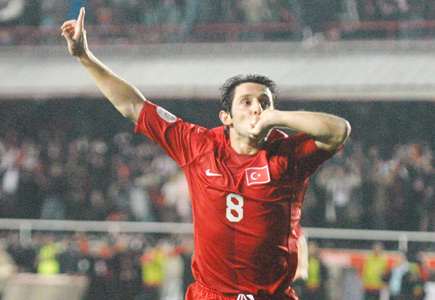
1. Nihat (Turkey) v. Czech Republic (group stage, r3) (above) - Just 15 minutes previously, the Czechs had been 2-0 up on Turkey, cruising into the Last-8. Then Arda Turan pulled one back, and Czech goalie Petr Cech, roundly known to be one of the best keepers in the game, fumbled a cross ball to Nihat's feet to bring the tie level. But this? Into injury-time, a ball is slipped through to Nihat in space, and from 20 yards out he thumps a high, dipping, curling ball over Cech and in-off the crossbar to seal a quite incredible comeback. The way Nihat struck the ball was so ambitious, and so risky - he could try that same shot 100 times and 90 of them would fly well over the bar and into the stand - that it seems like a silly thing to attempt in injury-time to clinch qualification. But he went for it, and pulled it off brilliantly.

Most Dramatic Moments:


3. Buffon saving Mutu's penalty - After being torn apart by the Dutch, the Italians are in danger of elimination if they lose to Romania. Adrian Mutu gives the Romanians the lead, before Panucci equalises for the world champions. But then Italy are harshly punished when the referee gives Romania a very soft penalty. Mutu, who plays his football in Italy with Fiorentina, steps up to take the kick knowing it's likely to eliminate his country of residence from the tournament. He hits is straight down the middle; Gigi Buffon has dived to his left, but sticks out his right hand as he falls; the ball hits Buffon's right hand, then his right leg, and balloons over the bar; Italy breathe again.

2. Turkey's comeback to beat Czech Republic - As described above. Nihat's injury-time winner was my favourite goal of the entire competition.

1. Turkey beating Croatia in the QF - Just ridiculous. 118 minutes of boring football. Eventually, some excitement: Rustu abandons his goal-line but Luka Modric gets there first to cross into the six-yard box, where Ivan Klasnic is waiting to head in, surely, the winning goal. Croatia go wild: the manager Slaven Bilic runs onto the pitch in celebration; they've done it! But no - never write off the Turks, especially after that Czech match. With their first shot on target all night, in the 122nd minute of the game - possibly the latest goal ever scored? - Semih Senturk (above) lashes the ball into the top corner. Incredible. The Turkish fans who were disconsolate can hardly believe their eyes; the Croatian fans who were celebrating can hardly believe their eyes. It's going to go to penalties, but we all know what's going to happen. The Croatians cannot recover from such a shock. Turkey win the shoot-out.

Surprises of the Tournament:


3. France - how dreadful were France? They had probably the best squad in the competition, on paper, and certainly the best squad depth - as I illustrated in the tournament preview, there were so many great French players who didn't even make the squad who most other nations would have loved to have at their disposal. But they were terrible. Their highlight was a 0-0 draw with Romania in possibly the worst game of the tournament. They scored just one goal - Thierry Henry in the 4-1 crumbling to the Netherlands.

2. Turkey - the biggest over-achievers, not only did the Turks escape from a group they were tipped to finish fourth in, they also made it to the semi-finals and outplayed eventual finalists Germany. Granted, they benefited from a few giant dollops of luck - if Petr Cech had just caught that cross, as he would do 99% of the time, Turkey would have gone straight home - but they also suffered plenty of bad luck against them. They only had 3 fit outfield subs for the Germany game, missing key players like Nihat, Arda, Tuncay, and Emre.


1. The Netherlands (above) - Going into the tournament, the Dutch were being regularly criticised by their own fans and journalists. Everyone knew they had good players, but nobody expected them to trounce both Italy and France so comprehensively. They instantly became every neutral's favourites. OK, so maybe it was just me that under-estimated them so much. I won't make that mistake again.

Top 3 Refereeing Controversies:


3. Austria's last-minute penalty v. Poland - English ref Howard Webb gave this decision which initially appeared to be a mystery - an Austrian was jostled to the ground as a free-kick was flighted into the box. The result? An equalising goal from 38-year old Ivica Vastic, effectively eliminating Poland from the competition. Was he right? It depends how rigidly you believe rules should be stuck to. By the letter of the law it was a foul and those fouls should be punished. But by being so strict, referees would have to give several penalties in every game, and that would fundamentally change the game of football. Indeed, Webb himself would have had to have given several penalties already in that game for the Polish defence to realise that they should be careful. So in my opinion he was not right - where were the other penalties in that game Mr Webb, or in the other matches you refereed? Instead, this penalty was like a gift given to the hosts, like a bottle of wine bought in thanks for a dinner party.

2. Van Nistelrooy's goal v. Italy - Ruud looked a good yard offside when he turned a shot towards goal, but it was given because Italy defender Panucci was off the pitch behind the goal. Apparently, because he hadn't asked the referee for permission to leave the pitch, he was still playing the striker onside. Again we have a situation where the strict interpretation of the law may be technically correct but gives an absurd result. The Italians felt aggrieved at the goal being given and I think they had a right to.

1. Kolodin's red card reprieve v. Netherlands (above) - With just minutes left, Slovakian referee Lubos Michel appeared to give Russian centre-back Denis Kolodin a second yellow card and then a red, but before Kolodin left the pitch, Michel ran over to speak to his assistant. The assistant seemingly told Michel that the ball had gone out of play, and therefore Kolodin's foul didn't count because play should have been stopped. Michel waved his hands to indicate that he had changed his mind about the red card, play carried on with Kolodin on the park, and Russia went on to win 3-1.

Television replays showed that the ball had not gone out of play, but also that Kolodin had barely made contact with the 'foul'. So it seems the assistant got it wrong, but that justice was done, because the referee had also got his first decision wrong, and so two wrongs made a right. But referees just aren't supposed to change their mind, because it gives players encouragement to harangue them about decisions they disagree with. So this was either a very brave decision, or a very bad example to set. What do you think?


Team of the Tournament:


GK. Edwin Van der Sar (Netherlands) - made more great saves than any other, and commanded his box. Honourable Mentions: Buffon (Italy), Casillas (Spain).


RB. Hamit Altintop (Turkey) - must have covered every blade of grass on every pitch he played on. HM: Bosingwa (Portugal), Bhoularouz (Netherlands)


CB. Carlos Puyol (Spain) - often criticised for his positioning, but the all-action defender never gives his opponents a second's peace. Team only lost 3 goals in 6 games.

CB. Giorgio Chiellini (Italy) - an absolute tank after he came in to replace Materazzi. HM: Pepe (Portugal), Gokhan (Turkey), Marchena (Spain).

LB. Yuri Zhirkov (Russia) - bombed up and down the left-flank with endless energy. A left-back and left-winger all-in-one. Brilliant. HM: van Bronckhorst (Netherlands), Lahm (Germany)

RW. Arda Turan (Turkey) - the new star of Turkish football, a constant danger, scored a couple too.

CM. Wesley Sneijder (Netherlands) - On course to be player of the tournament after the first two games, when he was a stand-out in Holland's magnificent group victories against Italy and France. HM: Fabregas, Xavi, Iniesta (all Spain), Modric (Croatia), Deco (Portugal).

CM. Andrei Arshavin (Russia) - Missed the first two games due to suspension, but was so good on returning against Sweden and particularly the Netherlands that he instantly became Europe's hottest property. Super-rich teams like Chelsea, Inter Milan and Barcelona are now set to battle for his £20m signature. Disappointing in the semi-final against Spain.

CM. Marcos Senna (Spain) - The so-called 'Makelele role' should be renamed the 'Senna role' now. The Brazilian midfielder intercepted everything and was the main reason creative players like Cassano, Arshavin, and Ballack were quiet against the Spanish.

LW. Lukas Podolski (Germany) - Germany's best player. Scored three goals and assisted a few too from the left flank.

ST. David Villa (Spain) - who else but the top scorer? HM: Pavlyuchenko (Russia), Nihat, Semih Senturk (both Turkey), Torres (Spain).

The end of a major International football tournament, like one minute past Christmas midnight, is a very sad time for me: because it's the longest possible time until the next one. You mean we have to wait two whole years for the next World Cup? I don't know how I'll cope. But if it's as good as Euro 2008, it'll be worth the wait.

Saturday, 28 June 2008

Euro 2008 Semi-Finals

feature for blogcritics
Germany 3 - 2 Turkey

This should have been easy for Germany. Turkey, decimated by injuries and suspensions, only had three fit outfield players on the bench, and were missing several of their best players like Nihat, Tuncay, Emre, Arda, and first-choice goalkeeper Volkan. Yet they still were by far the better team in this game, ditching their usual cagey style for an attacking attitude that saw them deservedly take the lead after 22 minutes. The German defence was static as the ball rebounded off the crossbar to the feet of Ugur Boral, who couldn't fail to score from a yard out.

But, as Turkey have barely held a lead all tournament (scoring so late means they've never had to), so it was again as Germany equalised four minutes later with their very first attack. A burst of left-wing pace from Podolski took him clear, and his low cross was deftly flicked home by Bastian Schweinsteiger (above). But Germany didn't capitalise on this quick comeback, which would have deflated teams of lesser mental strength than the Turks. Instead the game carried on as before, with Turkey making all the running, and Germany swanning around as if they wanted to win the game at walking pace.

With 11 minutes to go at the end of the game, and with the whole world blacked-out due to electrical storms in Vienna causing a cut in the TV broadcast, Germany took an undeserved lead. Big striker Miroslav Klose, who had barely even touched the ball up until this point, rose to meet a header and was delighted to see the ball bounce into an empty net as the Turkish goalkeeper, Rustu, had came for the cross and missed it completely. It was a horrible error from Rustu, who also made a horrible error against Croatia: how Turkey must curse the suspension of Volkan. But never write off the Turks, and sure enough they were able to score another last-5 goal - their fifth of the tournament.

Again it was little Semih Senturk who got it, glancing home at the near post after winger Sabri had humiliated Germany's much-vaunted left-back Philipp Lahm and got a cross in. But by their standards, Turkey had equalised too early - there was still four minutes to go! That's where Lahm made up for his defensive lapse by scoring a wonderful goal of his own making - bursting in from the left-flank, he played a one-two with Hitzlsperger before slamming the ball high past Rustu. But the late winner for Germany won't disguise the fact that they were very poor in this game.

Unusually considering their long-standing reputation, this looks like a German side which is very good going forward - mostly thanks to Podolksi and Schweinsteiger on the flanks - but very shaky in defence.


Spain 3 - 0 Russia

Russia were taught a lesson in the other semi-final. With hindsight, it seems some people (ahem) might have got a bit carried away after Russia's 3-1 beating of the Netherlands in the quarter-final, and with Andrei Arshavin's display too.

Here he was virtually anonymous, as Arsenal's Cesc Fabregas came off the bench to perform the Arshavin role much better for the Spanish. That substitution was the result of a first-half injury to David Villa, the competition's top-scorer who had bagged a hat-trick in Spain's opening game against Russia. He will now miss the final. Fabregas should probably start in his place, playing in the hole behind Fernando Torres, because he was in brilliant form here in that role. Barcelona midfielder Xavi (above) opened the scoring five minutes after half-time by sliding home a cross-cum-shot from club team-mate Andres Iniesta.

After that goal, the Russian's confidence and energy drained away from them entirely, and the result was never really in doubt. The Spanish midfield, the most impressive of the tournament, passed the ball through the Russians with ease, and it was Fabregas who made the telling pass for the second goal. His gorgeous flick landed in the path of substitute striker Dani Guiza, who chested it down and hooked the ball over the oncoming Russian goalkeeper Akinfeev. David Silva wrapped up the tie with a third goal eight minutes from time: some tidy close passing on the left-side of midfield ended with a lofted ball forward by Iniesta towards Fabregas on the wing; he took it forward and found Silva in the middle, who controlled it and drilled the ball low past Akinfeev with his left foot.

The Final
Germany v. Spain

Spain will go into the final as favourites. They have been the best side of the tournament: they won the full nine points in the group, drew with the world champions Italy and won the shoot-out, and easily beat a revitalised and much-fancied Russia in the semi-final. In contrast, Germany have huffed and puffed past their comparatively easy draw: they beat Poland with ease, meekly lost to Croatia, scraped past a dreadful Austria team, were good in dispatching with Portugal, and then stumbled past a half-strength Turkish side in their semi-final. They've lost four goals in the two knock-out games; and yes, they've scored six, but at least three of those were profits taken from basic defensive errors.

Podolski has been the key man for Germany so far, assisted here and there by good displays from Schweinsteiger, Ballack, and Lahm. But more players have had poor tournaments: yes I'm looking at you Mario Gomez, but also Marcell Jansen, Miroslav Klose, Simon Rolfes, Arne Friedrich and Jens Lehmann. In contrast, almost every Spanish player will come out of this tournament with enhanced reputations: Fernando Torres has been terrific up-front despite only scoring once, while the midfield of Senna, Xavi, Iniesta and Fabregas has been impossible to dispossess at times.

So on paper, everything points to a Spanish win. But football fans aware of their history will know it's not quite as easy as that: Germany are renowned as tournament experts, capable of grinding out results against less experienced opposition; Spain are renowned for being big-game bottlers, for always playing well while never being actually able to achieve anything palpable. Admittedly my predictions so far have been way off the mark (and unfortunately are published for everyone to see and mock), but I'll stick my neck on the line again anyway: Spain.


Or perhaps Germany.

Tuesday, 24 June 2008

Euro 2008 Quarter-Finals round-up


Portugal 2 - 3 Germany
In the first of the quarter finals, Group A winners Portugal took on Group B runners-up Germany. Both teams had stumbled in their groups: Portugal had fielded a reserve side and lost 2-0 to hosts Switzerland, while a full-strength German side had tepidly lost 2-1 to Croatia.

It was the Germans who were quickest from the blocks here, as a fast flowing move down the left-wing led to Bastian Schweinsteiger (above) sliding home the opening goal after 22 minutes. Just four minutes later the game looked all over, as poor Portuguese marking allowed Miroslav Klose a free header in the box, which he duly glanced into the net.

Portugal came back into contention just before half-time, when a Ronaldo shot was parried by Jens Lehmann, only for Nuno Gomes to slot home the rebound. In the second-half, Portugal's sloppy defending came back to haunt them again as German captain Michael Ballack found space in the area to head home a third goal.

Late pressure from the Portuguese was too little too late: Helder Postiga scored from a great Nani cross with three minutes to go, but there wasn't enough time to grab an equaliser. So the Portuguese fans have gone home; Big Phil Scolari has flown to Chelsea; Ronaldo has flown to Madrid; and Germany suddenly look a good bet again to win the trophy.


Croatia 1 - 1 Turkey (Turkey wins 3-1 on penalties)
Friday night's second quarter-final between Croatia and Turkey was, for so long, proving to be one of the worst games of the tournament. Croatia had qualified thanks to three wins out of three in Group B, including a victory over pre-tournament favourites Germany, and looked strong favourites to make the semi's. Turkey, on the other hand, had been leading in matches for a combined total of 2 minutes, after shock injury-time winners against both Switzerland and the Czech Republic.

This game never got going: Croatia attacked, Turkey defended doggedly, and neither side was able to create much. Turkey looked like they were playing for penalties the whole game, and it seemed that their negativity had finally caught up with them when Ivan Klasnic scored a header for Croatia in the 119th minute - one minute from the end of injury-time. Incredibly, Turkey's first shot on target the whole night didn't arrive until the 122nd minute, but when it arrived it was spectacular and unspeakably dramatic.

The 120 minutes of normal time plus extra time were up, and even the one-minute of suggested injury-time was up, when Turkish keeper Rustu Recber launched one last high ball into the Croatian penalty area. Time stood still, and so did the Croatian defenders as Semi Senturk lashed the ball into the top corner of the net.

Penalty shoot-outs are 90% psychological, and it was clear to everyone who would win this one: the Croatians were crushed, the Turks ecstatic. Modric and Rakitic missed for Croatia, Petric had his penalty saved by Rustu, and Turkey won 3-1. Turkey is in the semi-finals, and they've still only led matches for a combined total of 2 minutes of the 390 they've played in this tournament.


Netherlands 1 - 3 Russia (aet)
Saturday night saw new tournament favourites the Netherlands take on Dutchman Guus Hiddink's improving Russia team. While the Dutch had sensationally dispensed with Italy and France and rested their key players for a comfortable win over Romania, Russia had been annihilated 4-1 by Spain before easing past Greece 1-0 and putting on an exciting display of fast-moving attacking football in a 2-0 win over Sweden.

Surely their dodgy defence, so embarrassingly shown up by the Spanish, wouldn't be able to cope with the threat of van Nistelrooy, van Persie and Sneijder? In fact, they coped easily. Russia deservedly took a first-half lead through Pavyluchenko, and passed up several good opportunities to seal the points. They were outplaying the Dutch in midfield, with only Wesley Sneijder being able to cause problems for that dodgy Russian defence.

Just before full-time, a brilliant Sneijder free-kick was headed home by Ruud van Nistelrooy, taking the game to extra-time. But the added period saw a revived Russian side, who zipped around the park as if boosted by rocket fuel, inspired by a masterclass display by Andrei Arshavin (above). His ridiculous by-line cross allowed Dmitri Torbinski to slide home a second goal, before Arshavin himself nutmegged Dutch goalkeeper Edwin van der Sar for a third goal with four minutes left.


The Russians deserved their win, and suddenly the biggest clubs in Europe were all searching their pockets for £20m or so to buy 27-year old Arshavin, the new star of the tournament.

Spain 0 - 0 Italy (Spain wins 4-2 on penalties)

By Sunday night, it was left up to Spain to show that group winners could progress in the knock-outs. Croatia and Holland, the other 9-point winners in the group stages, had been evicted by group runners-up, while Group A winners Portugal had been dumped by Germany.

The big match build-up divided neutral fans between romantic and cynical lines: Spain had been enjoying by far the better tournament, the romantics said, and Italy were without their two first-pick central midfielders, Pirlo and Gattuso, due to suspension; it doesn't matter, said the skeptics, this is the way it always goes: Spain will play the best football, miss a load of chances, and be knocked out by a lucky Italian side.

This is "the way", they said, it is fate, and for a long time it looked like this pattern was indeed being followed: Spain attacked and missed; the Italians defended in bulk, and neutral fans around the world collectively groaned as Spain looked set to bottle it again. They didn't.

As the game headed into extra-time, the psychological game that so often determines the victor of high-tension matches like these strongly suggested the Italians would win: everything was going according to their plan, and so typically frustrating the Spanish. Remarkably, the better footballing side was able to triumph over the resilient and experienced Italians. Iker Casillas saved penalties from Daniele De Rossi and Antonio Di Natale, and Gigi Buffon saved one of his own, from Dani Guiza, but it wasn't enough. Arsenal's Cesc Fabregas converted the final spot-kick to give Spain a 4-2 victory, and the final place in the Euro semi-finals.


The Semi-Finals

Germany v. Turkey

It's hard to see anything other than a German victory here. Turkey has such selection concerns - including the loss of star striker Nihat to injury, and pacy young winger Arda to suspension - that they have threatened to play their third-choice goalkeeper, in outfield, out of necessity.

Even with a full team, this Turkish side could not be expected to triumph. In getting out of their group they have exceeded even the optimistic expectations of their own fans, and this lucky streak of scoring in injury-time in three successive matches surely cannot continue.

The Germans, on the other hand, are tournament experts. The were favourites before the big kick-off because they score highly on tactical discipline, mental strength, squad depth, the influence of their huge travelling support, and, of course, ability. They have shown their experience in growing through the competition so far, and in Michael Ballack and Lukasz Podolski have two of the players of the tournament so far. A Turkey victory on Wednesday evening would constitute an upset of epic proportions.


Russia v. Spain
Some people will tell you this is an easy one to call. Spain beat Russia 4-1 just two weeks ago, what's the difference now?

The difference is Andrei Arshavin, and a bit of momentum. Arshavin came back for the Sweden game, which Russia could have easily won by five or six goals, and was astonishingly effective against the Netherlands in their 3-1 quarter-final win. He is now being openly talked about as player of the tournament, after only two matches! He is so central to the way that Russia attacks, with five midfielders all willing to run beyond the ball and Arshavin as the fulcrum to take control and decide who gets it. Then there's Anyukov and Zhirkov, Russia's two flying full-backs, who have been exceptional.

Spain celebrated their win over Italy as if they had won the whole competition, and that would concern me as a fan. It's as if they felt Italy was the biggest potential stumbling block, and now that is overcome they should be able to waltz to the final. Not so. Who could foresee the Dutch being so outplayed by the Russians before? And the Spanish, probably the second-best team of the tournament after the Dutch, will be outplayed again here, in my opinion. At this level, football is rarely so straight-forward as to say that a 4-1 win before means another easy win now. For me, this is another extra-time Russian win.

Friday, 20 June 2008

Euro 2008 Group Stage, Round Three

feature for blogcritics

In Group A, hosts Switzerland exited the tournament in style with a 2-0 win over group leaders Portugal. The Portuguese, who had already qualified, fielded a reserve team to keep their whole squad sharp in preparation for their quarter-final tie, meaning key players like Deco and Ronaldo were rested. The Swiss took advantage by winning 2-0, with both goals coming from Hakan Yakin. Yakin finished the tournament as Switzerland's only goalscorer, with 3.

The other game was one of the most dramatic International matches in years- or, at least, the last 20 minutes was. Whoever won between the Czech Republic and Turkey would go through, with a penalty shoot-out in store were the game to finish level. Jan Koller and Jaroslav Plasil put the Czechs 2-0 up, leaving Turkey looking dead and buried. But just as they had made an amazing comeback against Switzerland in the previous game, the Turks came back again. First Arda pulled a goal back with 15 minutes to go. Then the Czech goalkeeper, Petr Cech (one of the very best goalkeepers in the world), made a huge mistake with just three minutes remaining by dropping a crossed ball at the feet of Nihat, who slotted the equaliser home. Two minutes later, the revitalised Turks scored a sensational winner, when Nihat curled a high dipping shot in-off the crossbar. The drama wasn't over yet - Turkey's goalkeeper Volkan was red-carded for pushing over Jan Koller in an off-the-ball incident. Having used their three substitutes already, Turkey had to ride out injury-time with an outfield player, striker Tuncay, in goal. But the dejected Czechs were unable to test him, and Turkey qualified with a 3-2 victory.

Group A Final Standings
(Columns are Played, Won, Drawn, Lost, Goal Difference, Points. Teams level on points are separated on a head-to-head basis first, on goal-difference second.)
Portugal.................3....2....0....1....+2...6
Turkey...................3....2....0....1.....0....6
Czech Republic.......3....1....0....2....-2....3
Switzerland............3....1....0....2.....0....3

Group B's final games weren't very exciting. With Croatia already qualified, they also fielded many of their second-choice players for the match against Poland. They still dominated, and won 1-0 thanks to a goal from Ivan Klasnic (above). Klasnic's story is remarkable - the big striker, who plays for Werder Bremen in Germany, suffered kidney failure in January of last year. He underwent a kidney transplant, but the organ was rejected, meaning he needed another transplant in March of 2007. Finally he was able to play football again at the end of the year, and returned to the Croatia squad in March. Though he still has to wear a protective shield around his mid-riff, his goal against the Polish marked the culmination of a truly impressive comeback. Croatia will now face Turkey in the Last 8.

In the other game, Germany struggled to beat Austria 1-0, thanks to a thunderbolt free-kick from captain Michael Ballack. There's a huge rivalry between Austria and Germany, mostly on the Austrian side, and they were putting everything they could into stopping the Germans. But they just didn't have enough quality up-front to threaten. Germany will now face Portugal in the first quarter-final.

Group B Final Standings

Croatia.................3....3....0....0....+3....9
Germany...............3....2....0....1....+2...6
Austria.................3....0....1....2....-2....1
Poland..................3....0....1....2....-3....1

Don't ever take financial advice from me. I predicted that France and Italy would both have qualified from Group C after two games, and that Holland would finish bottom. In fact, the Dutch had qualified in style after two games, while France and Italy faced each other in the play-off to qualify - but neither would if Romania could beat an under-strength Dutch team. The Netherlands did field a reserve team, but it still included top quality players like Arjen Robben and Robin Van Persie, who have only just returned from injury. Romania weren't able to take advantage of that though, going down 2-0 after goals from Huntelaar and Van Persie.

In the big play-off, a repeat of the 2006 World Cup final, France were dealt an early blow when flying winger Franck Ribery was carried off on a stretcher, to be replaced by Nasri. Italy soon took the lead when French centre-back Eric Abidal, in for the hugely experienced Lilian Thuram, brought Luca Toni down just as Toni was about to score. Abidal was sent-off and Pirlo converted the resulant penalty kick. Samir Nasri, who had only been on the pitch for 16 minutes after replacing Ribery, was taken off again as Jean-Alain Boumsong was needed to fill in for Abidal in defence. But without Ribery or Nasri, France were unable to create chances for Henry and Benzema up-front. A lucky deflection allowed a Daniele de Rossi shot to fly into the net with half an hour left, securing the 2-0 victory and qualification for Italy. The French embarrassingly finished bottom of the group, their 0-0 draw with Romania being their best result, and coach Raymond Domenech looks certain to lose his job. Still, he isn't too unhappy - the amateur astrologer bizarrely took the opportunity of being interviewed on live TV after the match to propose to his girlfriend. She said "oui", while the French fans gave an emphatic "non!"

Group C Final Standings

Netherlands...........3.....3....0....0....+8....9
Italy.....................3.....1....1....1....-1....4
Romania................3.....0....2....1....-2....2
France..................3.....0....1....2....-5....1


In Group D, Spain had already won the group thanks to wins over Russia and Sweden, so they allowed most of their reserve players to play instead of the first choicers. They faced holders Greece, who had already been eliminated from the competition, in a dead rubber game. But the Greeks took a shock lead in the first half thanks to Angelos Charisteas' bullet header. It was to be his and Greece's only goal of the tournament. Two late goals won the tie for Spain - first, Ruben de la Red slammed home with 30 minutes left, before Dani Guiza headed home the winner two minutes from time, 2-1. Spain will now face Italy in a quarter-final tie.

The second qualification spot behind Spain was up for grabs between Russia and Sweden, and it was the Reds who secured it was an easy 2-0 victory. Roman Pavyluchenko (above) opened the scoring in the first half after a wonderful flowing team move down the right wing, and recalled playmaker Andrei Arshavin doubled the Russians' advantage after the break after another pacy move down the flank. Really, 2-0 flattered the Swedes, who looked tired and slow in comparison to the fleet-footed dynamism of the young Russian team. Chance after chance was passed up, with Pavyluchenko particularly guilty of missing a few sitters, in a game that could easily have finished 5- or 6-0. The Russians, terrible in defence against the Spanish but thrilling going forward here, will now face current tournament favourites Holland in the quarter final.

Group D Final Standings
Spain.....................3....3....0....0....+5....9
Russia....................3....2....0....1.....0.....6
Sweden..................3....1....0....2....-1....3
Greece...................3....0....0....3....-4.....0


Monday, 16 June 2008

Euro 2008 Group Stages, Round Two

feature for blogcritics

The Netherlands have been killing it in the Group of Death, Group C. Fresh from their thrilling 3-0 victory over world champions Italy, the Dutch continued their sizzling form by thrashing World Cup finalists France 4-1. After an early goal by Dirk Kuyt, France passed up several chances to level the score. They were punished when Robin van Persie scored following a great cross by Arjen Robben, but then France pulled a goal back when Thierry Henry deflty glanced a Sagnol cross into the net. But within one minute, just when it looked like France might set up an exciting finish, the Dutch restored their two-goal advantage thanks to a wonderful solo strike from Robben. Wesley Sneijder put the icing on the cake in injury-time with a gorgeous 20 yard dipper that hit the crossbar on its way into the net. After two games against both World Cup finalists, the Netherlands have scored seven goals, won both games comfortably, and already won the group. They look unstoppable.

In the other Group C game, Italy were very nearly eliminated from the competition by a determined Romanian side, but the score finished 1-1, meaning both sides still have a chance of following Holland into the next round. A perfectly good Luca Toni goal was wrongly disallowed just before half-time before Romania took a shock lead when Adrian Mutu took advantage of a Zambrotta mistake to rifle the ball into the roof of Buffon's net. Italy were level just a few minutes later thanks to a tap-in from Panucci, but then the referee shocked everyone by giving Romania a very soft penalty. Mutu struck it hard, but Buffon kept it out with a combination of his right hand and right foot. If Romania can defeat the Dutch, they will qualify in second place, sending both World Cup finalists out. Otherwise, whoever wins the match between Italy and France will join the Netherlands in the Last 8.

In Group A, Portugal looked good again in defeating the Czech Republic 3-1. An early goal from the mercurial Deco was soon cancelled out by a great diving header from Czech winger Libor Sionko, who was excellent throughout. But in the second half, Deco set up Cristiano Ronaldo to drill home his first goal of the tournament. As the Czechs piled forward in search of an equaliser, an injury-time breakaway by Ronaldo earned Portugal their third goal, the Manchester United winger unselfishly setting up Quaresma to score into an empty net.

The Switzerland-Turkey game was somewhat farcical in the first half, as torrential rain turned the pitch into a quagmire. The Swiss adjusted to the conditions better, opening the scoring through half-Turkish midfielder Hakan Yakin, who was able to score from a yard out after a crossed ball stuck in the mud in front of goal. Fortunately the rain stopped and the groundsmen did a great job of sorting out the pitch at half-time, allowing the second half to be played like a normal game. That was unfortunate for Switzerland in the circumstances, because Turkey came more into the game, and equalised when substitute Senturk scored from Nihat's cross. In injury-time, the co-hosts were cruelly knocked out of the tournament as Turkish winger Arda cut inside and rifled a shot into the net, via a huge lucky deflection. It was harsh on the Swiss who had played well, but just as in the first game they were unable to take their chances, and were duly punished. Portugal have qualified from Group A, while the Czech Republic and Turkey effectively face a play-off to decide who will reach the next round.


In Group B, Croatia pulled off a big shock by beating tournament favourites Germany 2-1. Dario Srna opened the scoring on 21 minutes, and Ivica Olic (above) was in the right place to tap in a second goal after a shot was deflected off the post. Polish-born striker Lukasz Podolski, who scored twice for Germany against Poland, scored his third of the tournament later on, but midfielder Schweinsteiger was red carded in injury-time to complete a miserable day for the Germans.

The other Group B game, between Poland and Austria, was a minor farce. In an exciting first half, the only goal was scored by a Brazilian, Roger Guerrero, who obtained his Polish passport only last month after living in the country for two years. He was also clearly offside when he scored. But Austria equalised deep into injury-time at the end of the game after English referee Howard Webb mystifyingly awarded a penalty to the co-hosts, with no one quite sure why. 38-year-old Ivica Vastic scored, making him the oldest goalscorer in European Championship history, but really neither Guerrero or Vastic should have had the opportunity to score for either side. Still, the result keeps both countries in with a chance going into the final group game. Austria will have to beat Germany, while Poland will be hoping to beat Croatia. Frankly, neither result looks likely.

Finally, Group D favourites Spain sealed their qualification for the next round with an injury-time winner in a 2-1 win over Sweden. After being so impressive against Russia, the Spanish midfield was mostly nullified by a very well organised Swedish side. Fernando Torres scored the opening goal for Spain, but it was equalised soon afterwards by Zlatan Ibrahimovic. Neither side managed to create many chances in the second half and it looked destined to finish level before star man David Villa ran on to a long clearance and rifled home with just seconds left. In the other game, holders Greece were eliminated from the competition with barely a whimper, losing 1-0 to Russia. The Greeks were shockingly defensive in the first game, where they lost 2-0 to Sweden, and again they looked like they had no plan B when things weren't going their way. A 34th-minute goal from Zyryanov was enough to send the Greeks home early. Russia and Sweden will now play off for the second qualification place - a Last 8 match with the Netherlands awaits the not-so-lucky victors.

Thursday, 12 June 2008

Euro 2008 Group Stages, Round One


The first round of group games in Euro 2008 is complete, and everybody's talking about two teams — Holland and Spain.

Many pundits, myself included, predicted that the Netherlands would struggle in their impossibly tough group. But they confounded their critics with a magnificent display, beating world champions Italy 3-0. Their first goal, scored by Real Madrid striker Ruud van Nistelrooy, was highly controversial because he appeared to be clearly offside. Commentators and fans agreed that the goal should never have stood, but UEFA have since found a section of the official rule book which suggests the linesman got it right. Italian defender Christian Panucci, who was lying on his back behind the goal, apparently played van Nistelrooy onside because he hadn't asked the referee for permission to leave the pitch. But many fans aren't convinced by this interpretation, so the debate continues.

There was no doubt over Holland's second and third goals, both wonderful examples of counter-attack football scored by Holland's best two players of the night, Wesley Sneijder and Giovanni van Bronckhorst. The Dutch have already achieved more than many expected, so who knows what they can achieve now? In contrast, reports suggest that the Italian squad is furious with coach Roberto Donadoni, and they face a major challenge if they are to qualify for the next round.

Elsewhere in Group C, France were held to a disappointing 0-0 draw with Romania in one of the poorest games so far. Romania were understandably playing for a draw, and the French attack was unable to create many chances, or take them. France will now have to beat either high-flying Holland, or world champions Italy, to have any chance of progressing.

Spain provided the other big thrill of the first round of games, demolishing Guss Hiddink's Russia side 4-1. The star of the show was Valencia striker David Villa, who scored a stunning hat-trick. The other goal was scored by Arsenal's Cesc Fabregas, who came on as a substitute late in the game. The fact that he didn't start shows the remarkable strength of Spain's midfield, and Barcelona duo Xavi and Iniesta were wonderful in the middle against the Russians. Liverpool striker Fernando Torres also had a great game, so the Villa-Torres combination is looking ominously dangerous at this stage. Russia, for whom Pavyluchenko scored a late consolation, were shocking in defence, though they looked good in attack.

In Group D's other game, reigning champions Greece showed the weakness of their one-dimensional defensive football when they went down 2-0 to Sweden. The Greeks were completely unable to attack in the normal way — when they had the ball and Sweden sat back, they just did not know what to do. Sweden deservedly beat them without playing too well themselves, though Zlatan Ibrahimovic's opening goal was the kind of spectacular thunderbolt that deserves to win any game on its own. Despite how poor Russia were defensively, I still feel they have a chance of progressing from this group, as Greece look a very poor side and Sweden are only a little better.

In Group A, co-hosts Switzerland were unlucky to go down 1-0 to the Czech Republic in the tournament's opening match. A late goal from substitute Vaclav Sverkos was enough to settle the result, which was harsh on a Swiss side that created much without having the cutting-edge to deliver an equaliser. That could be put down to the loss of captain and star striker Alexander Frei, whose tournament was ended by injury just before half-time. In the other match, a sharp-looking Portugal side beat Turkey 2-0, thanks to goals from centre-back Pepe and an injury-time clincher from Raul Meireles.

Finally, Group B provided the least excitement of them all. Germany comfortably beat Poland 2-0 in a match that was more interesting for the off-field politics and rivalry than for the actual football. Ironically, it was Polish-born striker Lukasz Podolski who scored both goals, and both of them were set up by Polish-born team-mate Miroslave Klose. Podolksi tried his best not to celebrate either goal too much out of respect for his opponents. In the other group match, Croatia squeezed a 1-0 victory over co-hosts Austria, thanks to a 4th-minute penalty from midfielder Luka Modric.

Thursday, 5 June 2008

Euro 2008

feature for blogcritics


The UEFA European Football Championship 2008 kicks off on Friday, when co-hosts Switzerland host the Czech Republic in the first Group A game in Basel. The Euros are the third most-watched sporting competition in the world - after the FIFA World Cup and the Olympics - but this year there will be less interest for the English-speaking world, as none of the British Isles teams qualified.

England and Ireland both had disastrous campaigns which saw their homegrown managers being replaced by wily old Italians, while Northern Ireland and Scotland were quite heroic in their ultimately unsuccessful adventures: Northern Ireland's victories over Spain and Sweden, and Scotland's home and away triumphs over France, rank among both countries' finest ever results. Wales never really stood a chance in a tough group.

Still, most football fans will still be excited about the tournament, which showcases many of the world's finest players, a lot of them plying their trade in the English Premiership. Can Cristiano Ronaldo win this tournament on his own, just like Platini did for France in 1984? Can Spain, with Premiership stars like Fabregas and Torres, finally live up to their talent by showing it on the big stage? And can poor Austria avoid a total humiliation on their home soil? I can't wait to find out. Here's my Euro 2008 preview...

GROUP A


Portugal

FIFA World Ranking: 9

Odds: 7/1

Cristiano Ronaldo (above) is probably the best player in the world, and certainly the best player in Europe. His form at Manchester United this season has been sensational, and if anyone is capable of single-handedly winning this tournament, it's him.

But he won't need to - Portugal aren't a one-man team. In terms of transfer fees, their back four is probably the most expensive ever assembled in International football - Pepe and Carvalho both cost over £20m each, while Bosingwa and Ferreira cost Chelsea a combined £30m. In midfield they have Barca maestro Deco and Sporting's Miguel Veloso pulling the strings, with Ronaldo's young United team-mate Nani and Benfica star Simao on the wings.

Their main weakness is, as usual, a lack of a goalscoring centre-forward. They relied on Pauleta for years, but he never performed to his best at major tournaments, and he's now out of favour. Another former golden boy, Nuno Gomes, may take his place, but he's also less than world class. Of course, none of that will matter if Ronaldo can continue his club form in this tournament. Who needs a traditional central striker when the wide attacker can score 42 goals in a top-level season? If Ronaldo is at his best, it'll be virtually impossible to stop Portugal.

Czech Republic

FIFA World Ranking: 6th

Odds: 16/1

The Czechs have been perennially under-rated ever since they became a Slovak-free republic, but just now might be the time to actually not-rate them. They've lost the two key men of their last decade, unpredictable winger Karel Poborsky and the majestic Pavel Nedved, who've both got too old for International football; if that wasn't bad enough, they've lost Nedved's mercurial replacement, Arsenal's Tomas Rosicky, to a crippling hamstring injury.

It's now hard to see just where their genuine class is going to come from. Six-foot-eight-inch striker Jan Koller is always a danger, but he's due to retire after the tournament, and at 35 most defenders have now worked out how to mark him. Milan Baros, the top scorer at the last Euros in 2004, hasn't scored a single goal since joining Portsmouth in January.

That they finished above tournament favourites Germany in qualification is slightly deceptive - Germany's convenient last-day loss to the Czechs, 3-0 at home, gave them a seeding advantage for this stage. Of course, Chelsea's Petr Cech is one of the top three goalkeepers in the world, and players like attacking full-back Marek Jankulovski and winger Libor Sionko will offer some threat.

But this is no golden era for Czech football. Without Rosicky it's hard to see the Czech's replicating the successes of previous tournaments.

Switzerland

FIFA World Ranking: 48

Odds: 25/1

While easily the better of the two hosts, there's still few who believe Switzerland are truly among Europe's best 16 teams. A couple of years ago, the future looked very bright for the Swiss, but youngsters Vonlanthen, Barnetta, Djorou and Senderos have not fulfilled expectations. They still rely heavily on all-time highest goalscorer Alexander Frei up-front, but his best days are probably past him. Their other key players are centre-back Patrick Muller and midfielder Valon Behrami.

Having said all that, competition hosts always push a little bit harder when the big stage finally arrives on their doorstep - a host has got to at least the semi-final in every World Cup and European Championship in the last 20 years, other than the USA in 1994 - and Switzerland don't have a tough group. Portugal will likely win Group A, but the race for second place is a three way battle with Czech and Turkish sides who have seen better days. Their home advantage may just make the difference there - but with a likely meeting with Germany in the second round in store, the Swiss are sure to follow the Americans' lead in making a second-round home exit.

Turkey

FIFA World Ranking: 25

Odds: 33/1

This is the first tournament Turkey have qualified for since remarkably finishing third in the 2002 World Cup in Asia, but they go to Euro 2008 without the talismanic Hakan Sukur. With over 100 caps and over 50 goals, Sukur was arguably Turkey's greatest ever player. At 36, though, he's finally outstayed his national team welcome.

Instead, Turkey will play the pacy Villareal striker Nihat up-front and Turkey's success may well lie in how well he is supported. They have so many talented midfielders that it's likely coach Fatih Terim will play a 4-5-1, to squeeze as many of them in as he can, but Nihat struggles on his own and will need players like Newcastle outcast Emre and young Galatasaray winger Arda to help him out. But Turkey are difficult to read as Terim is a notorious tinkerer - he's been experimenting with players, formations and systems for so long, nobody really knows what he's going to do at the Euros.

What is predictable is that they will be locked in a three-way fight for second place in Group A with the Czech Republic and hosts Switzerland - so don't read too much into it if they lose their opening game against group favourites Portugal.


GROUP B


Germany

FIFA World Ranking: 5

Odds: 4/1

The Germans are most bookies' favourites, and understandably so. Unlike England, Germany have a knack of over-performing at major tournaments - think of WC2002, when the team predicted to flop reached the final, and of 2006's home-staged World Cup, where they were top scorers in finishing third. A championship in Austria-Switzerland is like a home tournament to the Germans, who will take massive support with them.

But also, for the first time in a while, the Germans have a squad worth getting excited about. Stalwarts like Ballack(above), Klose and Frings are still at the top of their games, while younger players like Lahm and Schweinsteiger are now established performers. Look out too for young Stuttgart striker Mario Gomez, who scored 28 goals in 32 games for his club this season, and has 6 in 9 caps for the national team. If the Germans have a weakness, it may be their goalkeeper: Arsenal's Jens Lehmann only played 13 times for his club last season. At 38, many feel it's time for him to be withdrawn from his national No. 1 spot too.

Austria

FIFA World Ranking: 101

Odds: 100/1

While the Austrians will undoubtedly be organised and welcoming hosts, there is huge fear in the country that their football team may be too welcoming to its competitors: explore our country, enjoy our hospitality, and feel free to score at will. Incredibly, Austria are now rated 101st in the FIFA World Rankings, putting them behind such giants as Qatar, Thailand and Gabon, and 43rd in Europe (on-the-spot quiz - can you even name 43 European countries?).

Austria have never been heavyweights, but they seem to be particularly suffering now from a lack of competitive match practice and a poorer-than-usual crop of players. Only midfielder and captain Andreas Ivanschitz really has the class to be playing at this level, though defenders Pogatetz and Stranzl are also important for the team. They're not bad defensively - however, they offer next to no threat going forward.

As with Switzerland, the pressure of hosting the tournament will probably help them over-perform, and a last-8 place isn't completely unthinkable considering the group they've been given. But many Austrians would be satisfied with just a draw against Poland and fighting, respectable performances against Germany and Croatia. Expectations for a host nation have never been so low.

Croatia

FIFA World Ranking: 13

Odds: 12/1

England's conquerers are still hurting from the absence of star striker Eduardo da Silva, whose leg was broken in a Premiership match last February while playing for Arsenal. But, y'know, they should stop crying, because Eduardo was never Croatian anyway - Brazilians aren't supposed to be eligible for European Championships, and the fact that only injury prevents him from appearing in this one makes a mockery of FIFA's eligibility rules.

Anyway, Eduardo's absence means the focus will turn to Spurs' new £16m signing, pocket-sized midfield playmaker Luka Modric, and he is ably assisted in the middle by Portsmouth's Niko Kranjcar. Mladen Petric will be the main centre-forward, but look out for Schalke's versatile young attacker Ivan Rakitic and 20-year old Hajduk Split striker Nikola Kalinic, who will both be looking to make an impression on the big stage. Croatia probably don't have enough fire power to be contenders for the title, but they should be able to ward off Austria and Poland to set up a quarter-final meeting with Portugal.

Poland

FIFA World Ranking: 27

Odds: 40/1

If you can choose to play with one striker or three, four defenders or six, two holding midfielders or none, why - the Polish must be asking - can't you choose to play with one goalkeeper or three? In Celtic's Artur Boruc, Arsenal's Lukasz Fabianski and Manchester United's Tomasz Kuszczak, Poland have real strength-in-depth in the only position where squad depth is unimportant.

If only they had such talent going forward, they wouldn't have to resort to fast-tracking Polish citizenship to a Brazilian winger, Roger Guerreiro, who first set foot in Poland just two years ago. They do have one very talented forward, Ebi Smolarek of Racing Santander, who scored nine goals during their impressive qualifying campaign which saw them top a group which also contained the Portuguese.

But a 3-0 home defeat to the USA in March has brought expectations crashing back down to earth, and despite being given a fairly favourable draw (read: they are in the same group as Austria so should achieve a minimum of three points), beating Croatia to second spot in Group B might just be beyond them.


GROUP C

France

FIFA World Ranking: 7

Odds: 9/1

France produces more great footballers than any other nation in the world - with the possible exception of Brazil, which is now exporting its surplus footballers to eastern Europe (see Croatia, Poland) - and the fact they were able to leave players of the calibre of David Trezeguet and Phillipe Mexes out of the squad altogether is quite incredible.

But what matters now is the 11 men on the park, and the French have incredible strength. Franck Ribery (above) was a sensation for Bayern Munich last season and will have to carry most of the creative burden now that Zidane has retired. In defence, Thuram and Gallas are still going strong, while Patrick Viera and Claude Makelele in central midfield have tonnes of experience. Thierry Henry hasn't had a great season for Barcelona, but he should still start up-front for France, possibly alongside Lyon's wonderful young striker Karim Benzema. Benzema is a superstar in the making, so this could well be his breakout tournament.

When they lost twice to Scotland in the qualifiers, they didn't manage to score a goal, and in truth they weren't able to create many chances: Makelele and Viera are great defensively, but they don't offer much flair. Then again, the French did beat world champions Italy in Paris, inspired by a magnificent Ribery.

Holland

FIFA World Ranking: 10

Odds: 12/1

The presence of the Dutch in Group C is what makes this the Group of Death - both World Cup finalists, plus the always-fancied Oranje, could be tournament winners, but one will have to exit early. There's so much attacking talent in this squad, and Real Madrid's Ruud van Nistelrooy would be a good bet for top scorer for anyone who thinks the Dutch will survive into the latter stages. It's surely time for Rafael van der Vaart to make his mark on the international stage, and Robin van Persie (if fit) can also have a huge impact.

But the Dutch are not in good form and many fans at home are pessimistic about their chances. Famed for the system of 'Total Football' introduced by Rinus Michels in the 70s, the Dutch have always attempted to follow this tradition, if not strictly, then at least to the point of pursuing an attractive style of passing football. Marco van Basten has somewhat abandoned this, putting all the emphasis on the results, and not always attaining them.

And the deployment of van Nistelrooy remains an issue too - according to some, fitting the goalscorer into the team upsets other balances which are not fully compensated for by his goals. That's why Manchester United sold him despite an incredible goalscoring record: having previously went three seasons without winning the title, United have since won two-in-a-row by adopting a more fluid attacking style.

Italy

FIFA World Ranking: 3

Odds: 7/1

The world champions - so they should win this one too, right? It is hard to see where the Italians' weaknesses are: they have one of the world's greatest goalkeepers in Gigi Buffon, and the Italians are renowned for their 'catenaccio' defensive solidity. Meanwhile, Andrea Pirlo and Rino Gattuso are a peerless central midfield pairing, and striker Luca Toni has been tearing through the German league this season for Bayern. Alex Del Piero has just had a great season for Juventus, and young Roma midfielder Alberto Aquilani has immense potential.

The Italians have so much experience at the top level, and the World Cup victory showed that they know how to deal with any situation - lesser teams would have crumbled during the Australia and Germany matches. Then again, they weren't hugely convincing in a qualifying campaign which included a draw with Lithuania and a defeat to France.

Romania

FIFA World Ranking: 12

Odds: 40/1

Romania were impressive in qualifying, finishing above Holland and scoring a goal-a-game more than their nearest rivals. They rely heavily on two players - Fiorentina's Adrian Mutu, a clever and skillful attacker who sets up just as many goals as he scores; and captain Christian Chivu, who can play in midfield or defence, central or on the left.

What they lack in star names they make up for in team spirit and tactical discipline, but to get out of this group their other players will have to be at their best. Razvan Rat, at left-back, is a brick wall who has apparently never missed a single game due to injury in his career - he is now 27. Going forward it will be winger Florentin Petre and Stuttgart's Ciprian Marica who will have to help Mutu cause problems against, well, two of the toughest defences in world football, and Holland's.

GROUP D


Spain

FIFA World Ranking: 4

Odds: 5/1

The Spanish have arguably the most talented squad in the tournament, but any on-paper analysis of their chances is made harder by their history of never doing themselves justice at major tournaments. Fernando Torres (above) was a sensation in the Premiership this season and is arguably the most on-form centre-forward in the world right now. Fabregas and Xavi in the middle is mouth-watering, Iker Casillas is one of the world's finest goalkeepers, and Sergio Ramos has just had an incredible season for Real Madrid at right-back.

Their squad is packed with top-level experience and class, and they don't seem to have any weaknesses. But we've said these things before about Spain - they've always had good squads and they've always disappointed. Arguably their biggest obstacle is psychological - if they can forget their history, bond as a team, and truly believe they can beat anyone they play, then they're more than capable of winning this tournament... in theory, at least.

Greece

FIFA World Ranking: 8

Odds: 20/1

The reigning champions - remember? Greece's victory at Euro 2004 is still hard to fathom, and it has been good and bad for football in different ways. On the positive it has given hope to underdogs everywhere, who can point to Greece and know that anything is possible with hard work and discipline. On the other hand, it has encouraged a very defensive style of football that relies on keeping a clean sheet and then hoping for a bit of luck at the other end.

Otto Rehhagel, the German coach who masterminded the victory last time out, is still the Greek manager, and he's still doing a great job. They demolished their qualifying group, which also included Turkey and Norway, and most observers say that this Greek side is better than it was four years ago. Look out for Gekas up-front, rampaging right-back Seitaridis, and silver-haired goalkeeper Nikopolidis, who is apparently in the form of his life at the age of 37.

But Greece has never been about individuals - Rehhagel's genius is in getting average players to play together and become better than the sum of their parts. Surely lightning cannot strike twice, can it?

Russia

FIFA World Ranking: 25

Odds: 22/1

Russia will benefit from their league season having just started a few months ago, so their players will be fresher than those who have just finished long club seasons. Their coach, Dutchman Guus Hiddink, is a tournament specialist, most famous for taking South Korea all the way to the semi-finals of the World Cup in 2002. And in players like goalkeeper Igor Akinfeev, right-back Alexander Anyukov, playmaker Andrei Arshavin, and striker Pavel Pogrebnyak, the Russians have talented and motivated youngsters who might just take complacent western Europeans by surprise.

Of course, if you saw Russia barely scrape through their qualifying group ahead of England thanks to the efforts of Croatia at Wembley, you won't have much confidence in them. Also to their huge frustration will be the absence of Arshavin for the first two games while he serves a suspension. But his inclusion in the squad suggests the Russians are expecting to be playing in more than just three matches.

Sweden

FIFA World Ranking: 23

Odds: 33/1

The Swedish reputation has been built on a solid well-organised defence and the heroics of Henrik Larsson up-front. At Euro 2008 their defence will be slightly more malleable, and Larsson, at 36, is only playing because he has been persuaded out of International retirement for the second time.

If that smacks a bit of desperation it's because a new generation of strikers hasn't really arrived yet. In qualification they finished second behind Spain, but while losing nine goals in twelve games would usually be viewed as a pretty good record, considering the Swedes had lost only eleven goals in the 36 games of three previous qualification campaigns, this might actually be seen as the first signs of cracking in their defensive brick wall.

Going forward, everything will rely on Zlatan Ibrahimovic - Larsson surely can't make a big impact again, can he? - who is one of the most talented attackers in the world on his day. If Zlatan decides to play, few will be able to stop him; but that's a bit 'if'.


So what will happen?

The Group of Death

Four teams among the top 12 of the world rankings, all in the same group? There's no doubt that Group C is the 'group of death' this year (though Group D is also tasty). France and Italy both qualified from Group B, and Romania and Holland both qualified from Group G, so these teams know each other.

In Group A, France won 3-1 in Paris against the Italians, and drew 0-0 in Milan, but came second in the qualifying group because the Italians had better results against the other teams.

In Group G, Romania were victorious over Holland 1-0 in Bucharest, and drew 0-0 away, eventually winning the group by 3 points. While Romania are the rank outsiders from this group, I can see them overcoming the Dutch again and finishing in third.

The France-Italy contest is on the last day of the group, when both teams may already have qualified, in which case they will both just be trying to avoid Spain in the next round.

The Dark Horses
First the UEFA Cup, then the Eurovision Song Contest - could Russia make it a fabulous treble by winning Euro 2008 as well? Greece's remarkable victory 4 years ago was far less likely at the beginning, and that taught us that while anything might not be probable, anything is possible. But Russian football is certainly on the rise, and even if they don't go far this time, it won't be long until Russia are a major force.

The Winners
On paper, France and Spain have the best squads: the individual players who are worth the most money, who win the most games and competitions for their clubs. Italy and Germany are the tournament experts whose tactical discipline and top level experience should help them go far.

Meanwhile, the romantics will be hoping Holland finally win the trophy their history of beautiful football deserves, or that the attacking spirit and pace of Portugal will be triumphant.

I'm going to go out on a limb here - the winners of Euro 2008 will be favourites Germany. Or Spain. Or Portugal. Or world champions Italy. Or France. Yep, definitely one of those five. Though Holland have a chance - if they get out of their group - as do the Russians...


and just for fun...

Breakout Tournament XI (a.k.a. Our Values Will Double in Four Weeks XI)
(4-4-2)
Igor Akinfeev (Russia, CSKA Moscow)

Aleksandr Anyukov (Russia, Zenit St. Petersburg)
Emre Gungor (Turkey, Galatasaray)
Dorin Goian (Romania, Steaua Bucharest)
Philipp Degen (Switzerland, Liverpool)

Luka Modric (Croatia, Spurs)
Ruben de la Red (Spain, Getafe)
Alberto Aquilani (Italy, Roma)
Andrei Arshavin (Russia, Zenit St. Petersburg)

Mario Gomez (Germany, Stuttgart)
Karim Benzema (France, Lyon)

We're Good, But Our Bloody Team-Mates Were No Help in Qualifying XI
(4-3-3)

Antti Niemi (Finland)

Alan Hutton (Scotland)
Nemanja Vidic (Serbia)
Daniel van Buyten (Belgium)
John Arne Riise (Norway)

Christian Poulsen (Denmark)
Anatoliy Tymoschuk (Ukraine)
Martin Petrov (Bulgaria)

Robbie Keane (Republic of Ireland)
Wayne Rooney (England)
David Healy (Northern Ireland)

Not Even In The French Squad But Still Better Than Most Other Countries' First XI's XI

(4-4-2)

Mickael Landreau (Paris-SG)

Bakary Sagna (Arsenal)
Philippe Mexes (Roma)
Julien Escude (Sevilla)
Gael Clichy (Arsenal)

Steed Malbranque (Spurs)
Alou Diarra (Bordeaux)
Mathieu Flamini (AC Milan)
Hatem Ben Arfa (Lyon)

Djibril Cisse (Marseille)
David Trezeguet (Juventus)

(subs: Pascal Chimbonda (Spurs), Sylvain Distin (Portsmouth), Mikael Silvestre (Manchester United), Jonathan Zebina (Juventus), Mathieu Valbuena (Marseille), Jeremy Menez (Monaco), Ludovic Giuly (Roma), Louis Saha (Manchester United)

Saturday, 9 February 2008

Is This The Death of English Football As We Know It?

Football report for Blogcritics.org


The Premier League in England announced plans on Thursday for a shake-up of their Premiership league system, involving a new 39th fixture to the season which would be played abroad. The plan, which is still said to be in its early stages, would involve a draw being made so that 10 further matches can be played, possibly at the end of the season, for the normal 3-point reward. Cities worldwide would be able to bid to host two matches each, which would then be allocated to them after the draw, to be played on a Saturday and a Sunday. The top five teams in the Premiership would be seeded for the draw so that they would not be able to face each other.

Premiership chairmen were enthusiastic about the idea. Birmingham's David Gold said, "We are making history. The Premier League, which is the greatest league the world has ever known, is being adventurous. I find this amazingly exciting".

Premier League chief executive Peter Scudamore said, "I think it's an idea whose time has come. It's an exciting prospect. All 20 clubs will benefit and there is a huge element of solidarity about it. When the league does well, other people in the football family do well in terms of redistribution. You can't stand still and if we don't do this then somebody else is going to do it. Every time there is an evolutionary step, the reaction of the fans is not always great, but I would ask them to take a step back and look at the positives".

The reaction from fans wasn't great, and they weren't able to find many positives. In fact the plan was condemned in strong terms by every fan willing to express a view. Forums and phone-in shows have been inundated with messages expressing extreme disappointment and anger at the idea. Though American sports fans may be used to franchising, English football fans cling to the view of their football club being innately linked to their community. The thought of playing an important league game - if it is played on the final day it could be the most important league game - in a foreign city where none of the local fans of either team can watch the game is anathema to the entire spirit of community that fans feel, and that clubs foster. If a club played one game a season abroad and it was a success, why shouldn't they extend it to five games, ten games, or every game?

The devoted home fans feel rejected by their clubs, who have squeezed them for all the money they've got and now want to fly to Asia or the Americas for new fans to financially exploit. As I have written before, football is so hugely popular in Europe because of the deep emotional attachment fans feel for their local clubs, which makes it far more important than just 'any old sport'.

The plan makes a mockery of the league system too. A club might well be relegated because they have to play Arsenal three times while their nearest rival faces Fulham three times. Likewise, a club may well win the league because they play Derby three times while their nearest rival faces the much-tougher Spurs on three occasions. Of course, these kind of scenarios can be imagined throughout the league, where higher positions always give greater rewards. The counter-argument would be that every club in the league would be voting for this change, so turkeys cannot complain after they have voted for Christmas. But the voting would be conducted by the chairmen with pound-signs in their eyes, rather than the managers or players who actually want to achieve things on the pitch.

The plan would certainly inject many millions of pounds into the Premiership. But any extra money the clubs would make would go straight into the pockets of the new wave of foreign billionaire chairmen. The Premiership is already easily the richest league in the world, and the gaps between clubs are increasing: the Big 4 is significantly richer than the others, who are significantly richer than the relegation fodder, who are significantly richer than the teams in the league below, and so on. This plan would continue to widen these gaps, consolidating permanent top flight status for the incumbent sides regardless of meritocratic reasons, creating a closed shop. If the top five teams were seeded, this would just consolidate their positions as the top, untouchable teams in the country. Nobody would challenge for the league title except these teams, and whoever was relegated would bounce straight back up again because they would be miles richer than the Championship teams. Eventually, it's easily foreseeable that relegation would be scrapped altogether, leaving very little motive for competition, and just a parade of consecutive showcase friendlies played out between brands.

What's more, this plan makes it easier for corruption to engineer the result of a league season. In any sport, any structural change must be calibrated so as to leave as little room as possible for parties who have multi-million pound interests in the outcome to abuse the system. It is quite obvious how a draw involving seeded sides for the final game of a league season could be manipulated so as to give a preferred outcome. For example, if the bookies stood to lose millions if Manchester United won the title, their final game could be drawn against a team like Spurs while nearest challengers Arsenal are given Derby. We should not presume that fixing only happens in cricket, or in athletics, or in tennis, or in horse racing, or in cycling, or in the football leagues of Italy, Germany and Brazil - we should instead presume that there will always be the potential for corruption in any sector (sporting or otherwise) which involves vast sums of money. As the sums increase, so does the potential for abuse. This plan involves the dangerous combination of vast sums of money and an extra mechanism for abuse.

It was perhaps inevitable that this was going to be suggested. When Abramovich bought Chelsea, his people told the press that he had recently fallen in love with the game and wanted a team to control, like a billionaire's toy. We all fell for it. Nobody asked any questions when Gaydamak bought Portsmouth, Glazer bought Man United, Lerner bought Aston Villa, Ashley bought Newcastle, Gillett and Hicks bought Liverpool, Magnusson bought West Ham, and Shinawatra bought Man City. When more and more billionaires bought Premiership clubs, we all just assumed they must love the game and want a toy.

That's nonsense.

We also know that running a football club is the quickest way to lose millions of pounds short of doing a KLF and setting it all ablaze. So what are these club owners doing? Where are the hidden or future revenue streams from which these billionaires are hoping to rake in the cash? Finally, the cat is out of the bag.

Ever since big money entered football, clubs and fans have been playing a mutually unspoken game. Clubs want fans because we give them money; fans give clubs money because we are helplessly devoted to them, brought up by our parents to invest our emotional livelihoods in the hands of the institution that represents our community. As long as the clubs don't make it too obvious that they're only interested in us for the money we provide, we'll keep providing it and we promise not to think about it any deeper. This plan is being wholly and unconditionally rejected by the overwhelming majority of English football fans, so here comes the crunch: if the clubs go ahead, they'll be starkly exposed as ruthless gold-diggers who are prepared to do anything for their next dollar or baht. We can live in denial no longer.

Friday, 25 January 2008

Scotland Appoint George Burley As National Boss

Football article for Blogcritics.org

The Scottish FA announced yesterday that George Burley would take over as national team manager. The move comes two months after the departure of Alex McLeish, who left to join Premiership club Birmingham City. Burley was chosen from a shortlist of five drawn up by the SFA, which also included former Derby boss Billy Davies, Motherwell's Mark McGhee, Celtic coach Tommy Burns, and Graeme Souness, whose biggest managerial success was with Rangers in the late 80s/early 90s.

Burley joins from English Championship (formerly First Division) club Southampton, with whom he'd been struggling to progress. As a player (mostly for Ipswich Town), he earned 11 Scotland caps before moving into management with Ayr United in 1991. By 1994 he had returned to the club where he had played for most of his career, eventually taking Ipswich to three promotion play-offs and the holy land of the Premiership in 2000. His first season in the top tier was an incredible success, as he took the small Suffolk club to fifth in the league and earned the Manager of the Year Award. However, they weren't able to sustain the success and were relegated the following season. In 2003 Burley took over at First Division Derby County and managed to save them from impending relegation. They struggled the following season, but a marked improvement in 04/05 saw them finish fourth in the table, just missing out on promotion through the play-offs. But behind-the-scenes issues made Burley's job untenable and he quit in June 2005, before taking over at Hearts.

Recent history was to repeat itself as Burley lasted just four months at Hearts before quitting due to interference from club owner Vladimir Romanov. His departure was galling for Hearts fans - and for neutral Scottish football fans - who had watched Burley compile a team that looked well capable of breaking the Old Firm's dominance by winning the Scottish Premier League. Hearts fans have struggled to forgive Romanov for forcing Burley out ever since.

Burley took over at Southampton shortly afterwards, and consolidated their position in the Championship despite substantial unrest at the club. In 2006/07, Burley led his side to the play-off places again, without success. Recently, Southampton have had to sell many of their key players, including Theo Walcott, Gareth Bale, and Chris Baird. Burley hasn't been able to adequately replace them, meaning the club has been struggling to put together consistent form and are hovering in the middle of the table.

Most Scotland fans I have spoken to are fairly happy with the news. Despite what some newspaper columnists are saying, the fans didn't want Souness or Burns to take over. Souness' entire reputation is built on his success at Rangers, but he had millions of pounds to spend to take a big team to success in a small league, and since then has failed with bigger challenges. Newcastle fans in particular are incapable of speaking of Souness without exploding into an abusive rage, such was his reputation at that club. Tommy Burns did reasonably well for Celtic in the mid-90s, but his rep is tarred by association as he was the Assistant Manager during Bertie Vogts' disastrous reign. In his one and only game as Scotland boss - following Vogts' dismissal - he presided over an inept performance and a 4-1 home defeat to Sweden.

Billy Davies ruled himself out early in the process, as he wants his next job to be in club football. The other serious candidate, who appeared to be the slight favourite with most fans, was Motherwell manager Mark McGhee. In England he had won two titles and two further promotions in the lower leagues, though had also suffered relegation as Brighton manager. But his supporters were mostly impressed by the turnaround he has inspired in Motherwell this season: a team that was flirting with relegation last season is playing attacking, expressive football this season, and are sure to finish in the top 6. The shock death of team captain Phil O'Donnell one month ago made his situation at Motherwell difficult: he has since developed such a connection with the club that he insisted he wouldn't leave before the end of the season, even if Scotland did come calling. Perhaps it was this admirable resolve which swung the balance in Burley's favour in the end.

Although Scotland have no competitive games until the autumn, they are due to play a home friendly against Croatia in March.